
Introduction: The Battle for consumer Attention
In today’s digital environment, attention has become one of the most valuable resources. People scroll through social media feeds, browse websites, watch short-form videos, and interact with advertisements every day. As a result, businesses face an increasingly difficult challenge: how can they make people stop scrolling and pay attention? This question sits at the heart of modern digital marketing.
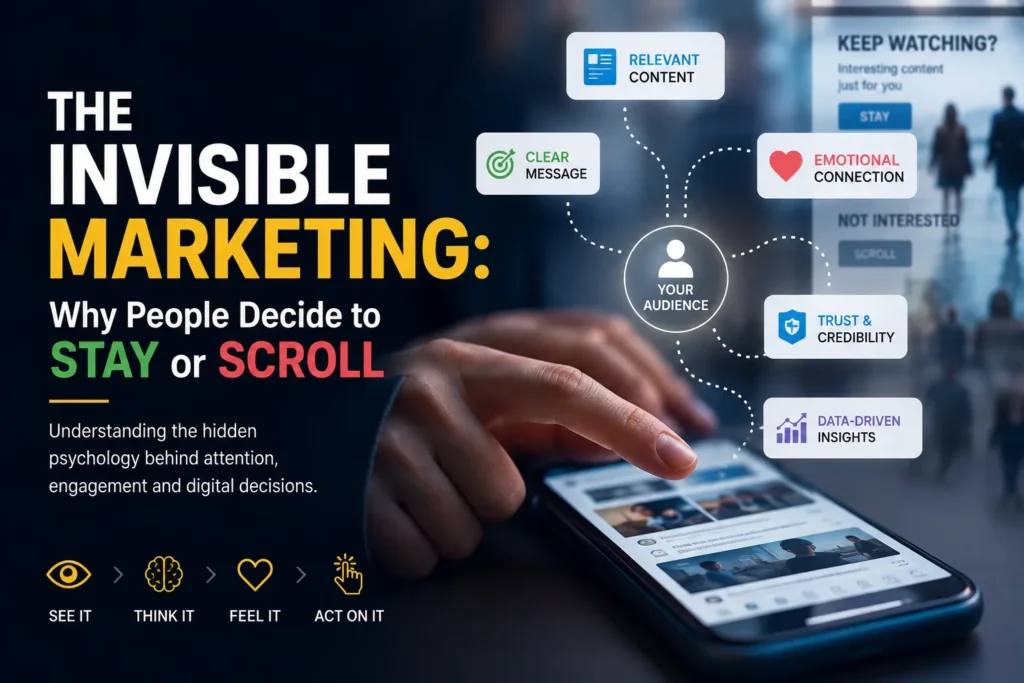
However, successful marketing does not always begin with a purchase, a click, or even a “like.” Often, it begins with a much smaller decision: Should I stay, or should I scroll? This decision can happen within seconds. People constantly evaluate visual design, headlines, emotions, relevance, and credibility before deciding whether content deserves their attention. Therefore, understanding this invisible decision-making process can help marketers create more meaningful and effective digital experiences.
The Three-Second Decision
When people encounter content online, they rarely approach it with complete attention. Instead, they scan the screen while thinking about other things. Consequently, marketers have only a brief opportunity to communicate value. A headline, image, opening sentence, or video frame must immediately give users a reason to continue.
Moreover, this first impression often happens before people consciously analyze the content. Users instinctively evaluate whether something looks relevant, interesting, useful, or entertaining. If the content fails to create curiosity, they simply move on.
Attention Is Not the Same as Interest
Capturing attention does not automatically mean creating genuine interest. A bright image or controversial headline may stop someone temporarily, but the content must provide a reason to stay. Otherwise, the initial attention disappears almost immediately.
For example, a sensational headline may generate thousands of impressions, yet users may leave when the article fails to deliver what it promised. In contrast, relevant and valuable content encourages people to continue reading, watching, or exploring. Thus, marketers should treat attention as the beginning of a relationship rather than the final objective.
The Psychology Behind the Scroll
Scrolling has become an automatic behavior for many internet users. People often browse content without consciously deciding what they want to see next. Nevertheless, their brains continuously filter information and prioritize content that appears personally relevant.
This process explains why personalization has become such an important part of digital marketing. When content reflects a person’s interests, problems, goals, or emotions, it feels more relevant. As a result, the person becomes more likely to pause. However, marketers must use personalization responsibly because excessive targeting can make users feel uncomfortable or manipulated.
The Power of the First Impression
Visual presentation strongly influences whether someone continues interacting with content. Before reading a paragraph, users notice colors, images, typography, spacing, composition, and overall design. Therefore, a professional visual experience can significantly improve the chances of retaining attention.
Furthermore, consistency strengthens this first impression. When a brand uses recognizable visual elements across its website, social media platforms, and advertisements, users can identify it more easily. Over time, this consistency can contribute to brand recognition and trust. Consequently, design should not function merely as decoration; it should support communication and influence user behavior.
Words That Make People Stop
Although visuals attract attention, words often determine whether users continue. A strong headline creates a clear expectation and gives readers a reason to explore further. For this reason, marketers should avoid vague statements and focus on specific benefits, questions, problems, or ideas.
For instance, “Improve Your Marketing” sounds generic, whereas “Why Your Customers Leave Before They Buy” creates curiosity and addresses a specific problem. The second headline encourages readers to discover the answer. Similarly, effective copy should communicate value quickly while maintaining authenticity. In other words, the goal is not to manipulate attention but to earn it.
Emotion Is an Invisible Trigger
People do not make digital decisions based entirely on logic. Emotion frequently influences whether someone stops, shares, remembers, or responds to content. Happiness, curiosity, surprise, concern, inspiration, and even frustration can influence user behavior.
However, successful emotional marketing does not require exaggerated claims. Instead, brands can connect with audiences by understanding their real experiences. A business that demonstrates empathy and addresses genuine customer challenges can create a stronger emotional connection. Therefore, emotional intelligence should become an important part of modern digital marketing strategies.
Relevance Beats Noise
The internet contains an enormous amount of content. Every day, businesses publish articles, advertisements, videos, emails, posts, and promotional messages. Because users cannot consume everything, they naturally prioritize information that appears relevant to their current needs.
Consequently, marketers should understand their audience before creating content. They need to identify common questions, frustrations, interests, and goals. When a message directly addresses these factors, users have a stronger reason to pay attention. In contrast, generic content often becomes part of the digital noise. Ultimately, relevance provides a stronger competitive advantage than simply publishing more content.
The Role of Trust
People may stop scrolling because something looks interesting, but they stay when they believe the source deserves their attention. Trust therefore plays a critical role in retaining audiences. Clear information, authentic communication, consistent branding, social proof, and credible evidence can all contribute to trust.
Furthermore, trust becomes particularly important when a brand asks users to take action. Whether the desired action involves subscribing to a newsletter, downloading a resource, contacting a business, or making a purchase, people need confidence before proceeding. Therefore, effective digital marketing should build credibility throughout the customer journey instead of focusing exclusively on immediate conversions.
Data Reveals Why People Stay
While psychology explains many user decisions, data helps marketers identify actual behavior. Metrics such as watch time, bounce rate, engagement rate, click-through rate, conversion rate, and page retention can reveal how audiences respond to content.
For example, a video may receive thousands of views but lose most viewers within its first five seconds. That pattern suggests that the opening fails to maintain attention. Similarly, a website may attract substantial traffic but generate very few conversions. In that situation, marketers need to investigate the user experience rather than simply celebrate the traffic numbers.
Therefore, data analytics can transform invisible user behavior into measurable insights. Instead of guessing why people scroll away, marketers can examine patterns and make informed improvements.
From Attention to Action
Stopping the scroll represents only one stage of the customer journey. After capturing attention, brands must provide enough value to encourage the next step. This could mean reading an article, watching a complete video, visiting a website, joining a mailing list, or purchasing a product.
Therefore, every piece of content should have a clear purpose. Marketers should understand what they want users to think, feel, or do after consuming the content. At the same time, the action should feel natural rather than forced. When content delivers value first, audiences become more willing to engage with the brand.
Why Authenticity Matters More Than Ever
As artificial intelligence and automation become increasingly common, audiences are exposed to more content than ever before. Consequently, generic and repetitive messages can quickly become difficult to distinguish. Authenticity has therefore become an increasingly valuable marketing advantage.
Brands can demonstrate authenticity by sharing real experiences, transparent information, useful insights, and human perspectives. Instead of attempting to appear perfect, businesses can communicate honestly about challenges and solutions. As a result, audiences may develop stronger connections with brands that feel genuine rather than overly promotional.
The Future of Invisible Marketing
The future of digital marketing will increasingly focus on understanding the subtle factors that influence attention. Artificial intelligence, behavioral analytics, personalization, predictive technology, and user experience design will allow marketers to understand audiences more precisely.
Nevertheless, technology alone will not guarantee success. People will continue to value relevance, trust, simplicity, creativity, and genuine human connection. Therefore, marketers who combine data with empathy will have a stronger opportunity to create meaningful experiences. The future will not belong simply to the brands that publish the most content. Instead, it will belong to brands that understand what their audiences truly value.
Conclusion: Earn the Pause
Every scroll represents a decision. Every pause represents an opportunity. However, brands cannot expect people to stop simply because they have published something. They must provide a compelling reason to stay.
The invisible side of digital marketing lies within these tiny moments of decision-making. A strong headline, meaningful visual, relevant message, emotional connection, trustworthy brand, and valuable experience can transform a passing impression into genuine engagement. Moreover, data can help marketers understand which elements work and which require improvement.
Ultimately, successful marketing is not about interrupting people’s attention. It is about earning their attention. When brands understand why people stay instead of scroll, they can create content that does more than generate views—it can build relationships, encourage action, and create lasting value.