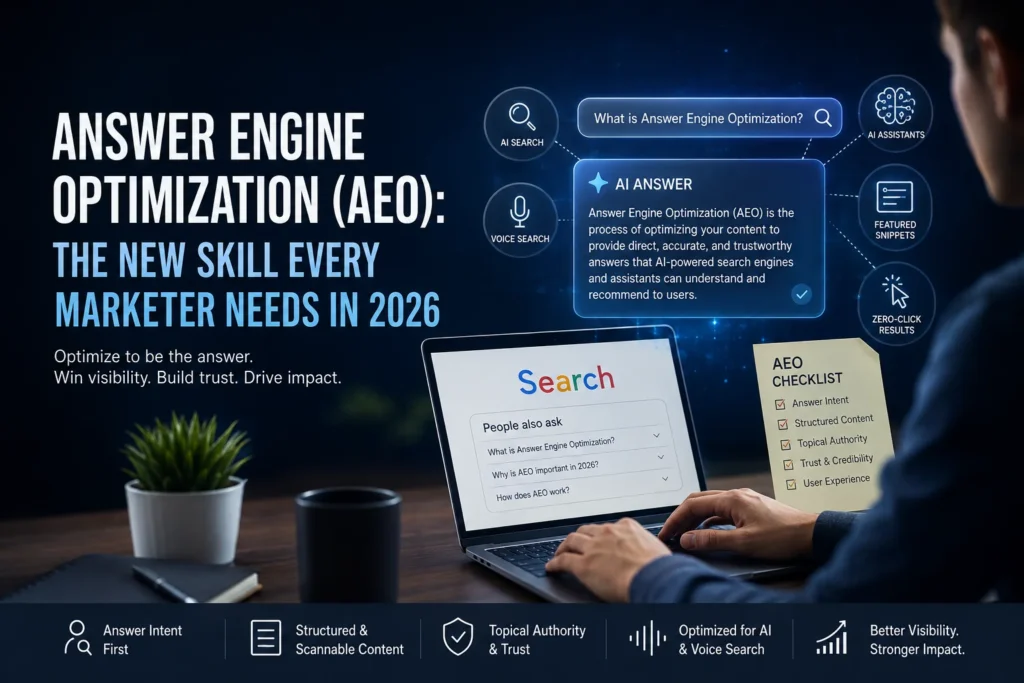
Answer Engine Optimization (AEO): The New Skill Every Marketer Needs in 2026
From Search Engines to Answer Engines The way people search for information has changed dramatically. For years, marketers focused primarily on optimizing websites to appear on traditional search engine results pages. However, the rise of artificial intelligence is transforming this process. In 2026, users increasingly expect search platforms and AI-powered tools to provide direct, accurate, and useful answers instead of simply presenting a list of websites. This shift has made Answer Engine Optimization (AEO) an increasingly important skill for modern marketers. Answer Engine Optimization focuses on creating content that artificial intelligence systems and search platforms can easily understand, extract, and present as answers. Unlike traditional SEO, which primarily aims to improve website rankings, AEO focuses on becoming the source that answer engines choose when responding to users. Consequently, marketers must rethink how they create, structure, and optimize content. This development represents an important evolution in digital marketing. What Exactly Is Answer Engine Optimization? Answer Engine Optimization, commonly known as AEO, is the practice of optimizing digital content so that answer engines can identify and use it when generating responses to search queries. These answer engines may include AI-powered search experiences, conversational assistants, voice assistants, and other systems that provide direct answers to users. Traditional SEO often concentrates on keywords, backlinks, technical performance, and rankings. AEO, on the other hand, places greater emphasis on answering questions clearly, demonstrating expertise, providing trustworthy information, and organizing content logically. Therefore, successful marketers in 2026 need to understand both SEO and AEO rather than treating them as completely separate strategies. Furthermore, AEO does not mean that traditional SEO has become irrelevant. Instead, the two strategies complement each other. Strong technical SEO can help search systems discover and understand content, while effective AEO can increase the likelihood that those systems will select the content as a direct answer. As a result, marketers should develop an integrated approach that combines both disciplines. Why AEO Matters More Than Ever in 2026 Consumer behavior continues to move toward faster and more convenient information discovery. People increasingly ask complete questions rather than entering short keyword combinations. For example, instead of searching for “best digital marketing tools,” a user might ask, “Which digital marketing tools should a small business use in 2026?” Answer engines are designed to understand these conversational questions and provide contextual responses. Moreover, users increasingly value convenience. They may not want to visit several websites and compare information manually. Instead, they expect technology to summarize relevant information and provide an immediate answer. Consequently, marketers must create content that addresses specific questions directly and efficiently. This shift creates both a challenge and an opportunity. Brands that continue using outdated content strategies may lose visibility in AI-driven search environments. However, businesses that adapt early can establish themselves as reliable sources of information. Therefore, AEO should become an essential component of modern digital marketing strategies rather than an optional experiment. The Rise of Zero-Click Searches One of the most important changes in modern search behavior involves zero-click searches. A zero-click search occurs when users receive the information they need directly within the search experience without clicking through to another website. Featured snippets, knowledge panels, AI-generated responses, and other search features have contributed to this trend. At first, zero-click searches may appear to create a problem for marketers because users may not visit their websites. However, appearing as a trusted source within an answer can still generate valuable brand exposure. A user who repeatedly encounters a company’s information in relevant answers may begin to recognize and trust that brand. Therefore, marketers should not measure success only through website traffic. Brand visibility, authority, citations, mentions, and influence within AI-generated answers can also provide meaningful indicators of performance. In addition, marketers should develop content that encourages users to continue their journey when deeper information or a product solution is required. Creating Content That Answers Real Questions Effective AEO begins with understanding what audiences actually want to know. Marketers should move beyond broad keywords and investigate the questions customers ask throughout the buying journey. These questions may involve product comparisons, pricing, benefits, problems, solutions, tutorials, recommendations, and industry trends. For example, a digital marketing agency should not simply publish an article targeting “digital marketing.” Instead, it could answer questions such as “How does digital marketing help small businesses?” or “What are the most effective digital marketing strategies for local businesses?” Such specific questions provide clear opportunities to create useful, answer-focused content. Furthermore, marketers should place direct answers near the beginning of relevant sections. They can then expand on those answers with examples, explanations, statistics, and supporting information. Consequently, both users and answer engines can understand the central message quickly. Structure Is the Secret Weapon of AEO Content structure plays a crucial role in helping AI systems understand information. Well-organized content allows search technologies to identify relationships between questions, answers, topics, and supporting details. Therefore, marketers should use clear headings, subheadings, short paragraphs, bullet points, numbered lists, tables, and frequently asked questions where appropriate. In addition, marketers should write with clarity rather than unnecessary complexity. A direct question should receive a direct answer. For example, a section titled “What Is AEO?” should immediately define AEO before providing a deeper explanation. This structure makes content easier for both human readers and intelligent systems to interpret. Furthermore, semantic relevance matters. Marketers should naturally include related concepts rather than repeatedly inserting the same keyword. For instance, an article about AEO may naturally discuss AI search, conversational queries, search intent, voice search, structured content, expertise, and content authority. As a result, the content develops greater topical depth. AI Search Is Changing the Marketer’s Role Artificial intelligence is not simply changing search technology; it is changing the role of the marketer. Previously, marketers often focused heavily on keyword rankings and traffic acquisition. Now, they must also consider how AI systems interpret information and determine which sources deserve to be included in generated answers. Consequently, marketers need stronger research and analytical skills. They must understand user intent, identify information gaps, evaluate